

Steve Henn
Steve Henn is NPR's technology correspondent based in Menlo Park, California, who is currently on assignment with Planet Money. An award winning journalist, he now covers the intersection of technology and modern life - exploring how digital innovations are changing the way we interact with people we love, the institutions we depend on and the world around us. In 2012 he came frighteningly close to crashing one of the first Tesla sedans ever made. He has taken a ride in a self-driving car, and flown a drone around Stanford's campus with a legal expert on privacy and robotics.
But Steve's favorite technology stories are the ones that explain how little-understood innovations can change the way millions of us behave. Why do people buy cows in Farmville? Why are video games so compelling and why do some people have such a hard time setting Twitter aside? He is fascinated by how digital companies attempt to mold our behavior and study our every move in a world where we are constantly interacting with connected devices.
Prior to moving to Silicon Valley in 2010, Steve covered a wide range of topics for the public radio show Marketplace. His reporting kicked off the congressional travel scandals in late 2004, and helped expose the role of private military contractors at Abu Ghraib.
At Marketplace, Henn helped establish collaborations with the Center for Public Integrity and the Medill's School of Journalism.
Steve spent his early life on a farm in Iowa where his parents, who are biochemists, hoped to raise all their own food and become energy self-sufficient. It didn't work. During college Steve hoped to drop out and support himself by working in the fishing industry in Alaska. That also didn't work. After college he biked around the country with his sweetheart, Emily Johnson. He then followed Emily to Africa, volunteering at Soweto Community Radio. That did work out. He and Emily are now happily married with three daughters.
Steve graduated from Wesleyan University's College of Social Studies with honors and Columbia University's Graduate school of Journalism.
-
Yahoo has hired Google executive Marissa Mayer to run the struggling Internet company. Mayer, a 13-year Google veteran, will face a tough task trying to reverse Yahoo's sagging fortunes.
-
Mobile apps are aggressively placing unwanted ads on phones. Lookout, a mobile security firm in San Francisco, tested mobile apps and found some disturbing practices. Those include transmitting consumer phone numbers and email addresses and transmitting to third parties and placing ads on the mobile phone's desktop.
-
Google is expected to pay a $22.5 million fine for breaching the privacy settings for millions of Apple users. The case targets Google's use of a computer code that tracks web searches from Apple"s Safari even when users had explicitly blocked the tracking from occurring.
-
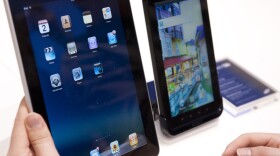 Samsung won a patent battle against Apple in a British courtroom Monday. Judge Colin Birss ruled Samsung's Galaxy tablet just isn't cool enough to be mistaken for an Apple iPad.
 -
 PayPal and other tech companies have set their sights on transforming how we shop at retail stores. New services allow customers to pay with their smartphone, or even just a personal identification number and a cellphone number. But these new digital wallets are still tied to transaction fees charged to merchants.
 -
 The Wall Street Journal says the days of "wild user growth appear to be over" at Facebook. The Next Web says Facebook is "eating the world" (except for China and Russia). Taking a closer look at the numbers, both stories can be right.
 -
Facebook's stock price continues to tumble after its tumultuous IPO. Shares are down more than 25 percent since the opening day of trading last month. This all comes as more analysts question if Facebook can generate advertising revenues to justify its lofty valuation.
-
 Would you get nearly naked before your computer in search of a better-fitting dress or the perfect pair of jeans? A British company is hoping to convince millions of us to do just that — scan our bodies for commerce.
 -
Facebook begins public trading Friday at $38 a share. The social networking company boasts 900 million users, giving it undeniable clout in the marketplace. Whether Facebook can generate enough profit to justify its valuation is another matter.
-
 Facebook's initial public offering — $16 billion and counting — is shaping up to be one of the largest in history. The company and its investors are betting that the social media giant can learn enough from its users so it can target ads that will be worth big, big money.


